

FLRT 1MCC FREEWHEELER (2017)
Evaporative emissions components
8 parts
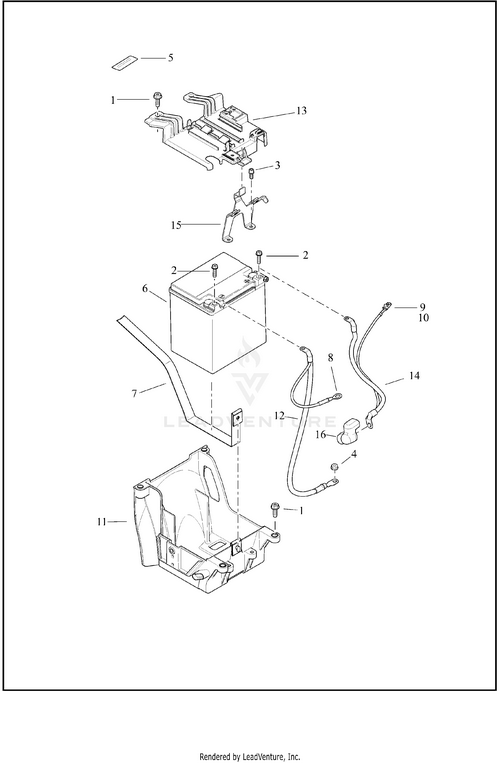
This exploded view details the 8 parts of the Evaporative emissions components subassembly for FLRT 1MCC FREEWHEELER (2017). Click a part number in the table to open its page.
Exploded view
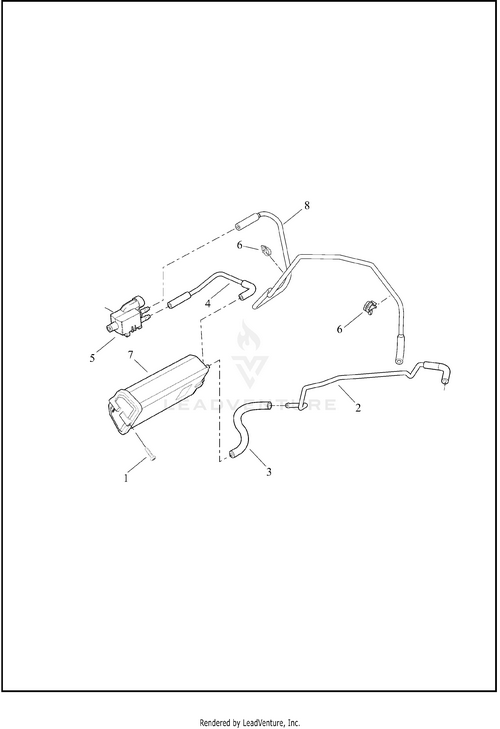
Parts list
| # | Ref. | Name | Qty | Price | Buy |
|---|---|---|---|---|---|
| 1 | 4612Torx/Plastite pan screw | Torx/Plastite pan screw SCREW,PAN,TORX/PLASTITE | 2 | €2.16 | |
| 2 | 27291-09ACarbon canister hose, X | Carbon canister hose, X HOSE,CARBON CSTR,X | 1 | €19.97 | |
| 3 | 27297-09ACanister purge EVAP line | Canister purge EVAP line EVAP LINE,CANISTER,PURGE | 1 | €19.72 | |
| 4 | 27298-09APurge-to-canister EVAP line | Purge-to-canister EVAP line EVAP LINE,PURGE-TO-CANISTER | 1 | €19.18 | |
| 5 | 27715-07Purge valve solenoid | Purge valve solenoid SOLENOID,PURGE VALVE | 1 | €38.44 | |
| 6 | 70681-09Wiring harness clip | Wiring harness clip HARNESS CLIP | 2 | €7.45 | |
| 7 | 60800006Carbon canister | Carbon canister | 1 | €199.20 | |
| 8 | 60800026Carbon canister purge hose | Carbon canister purge hose HOSE,CARBON CSTR,PURGE | 1 | €34.56 |
Ask a question
A question about this exploded view or one of its parts? Write to us and we will answer by e-mail.
Other diagrams for FLRT 1MCC FREEWHEELER (2017)
See more
About this exploded view
This “Evaporative emissions components” diagram covers the Trike model FLRT 1MCC FREEWHEELER (2017) and shows 8 parts. Of these, 8 can be ordered online. Characteristic parts of this diagram: Carbon canister hose, X, Canister purge EVAP line, and purge valve solenoid. Parts can differ by market and production date, so the motorcycle’s VIN remains the reference for checking a part.
Instead of letting fuel vapour escape from the tank into the air, the evaporative emission control system stores it in a charcoal canister. When the engine runs, a purge solenoid valve opens so that the intake can draw the stored vapour in and burn it. Besides the canister and purge valve, it uses vapour hoses and lines between tank, canister, valve and intake, elbows and connectors, and a tank vent valve. The system is fitted according to market regulations, with routing and canister position varying by model. A smell of fuel, a cracked or disconnected hose, a faulty purge valve or tank venting problems usually trace back to it.